
Introduction
“Feminism.”
It’s a word that sparks debates, emotions, and sometimes even discomfort. For some, it represents empowerment and equality; for others, it’s misunderstood as a movement that promotes superiority over men. But at its core, Feminism is about one simple idea: equality.
Growing up, many of us have seen subtle differences in how boys and girls are treated—whether in education, career expectations, or even freedom of choice. These experiences quietly shape our understanding of the world. Feminism emerges from these lived realities, challenging inequality and advocating for fairness.
In today’s rapidly evolving society, where women are leading businesses, shaping policies, and breaking barriers, Feminism is not outdated—it’s more relevant than ever.
What is Feminism?
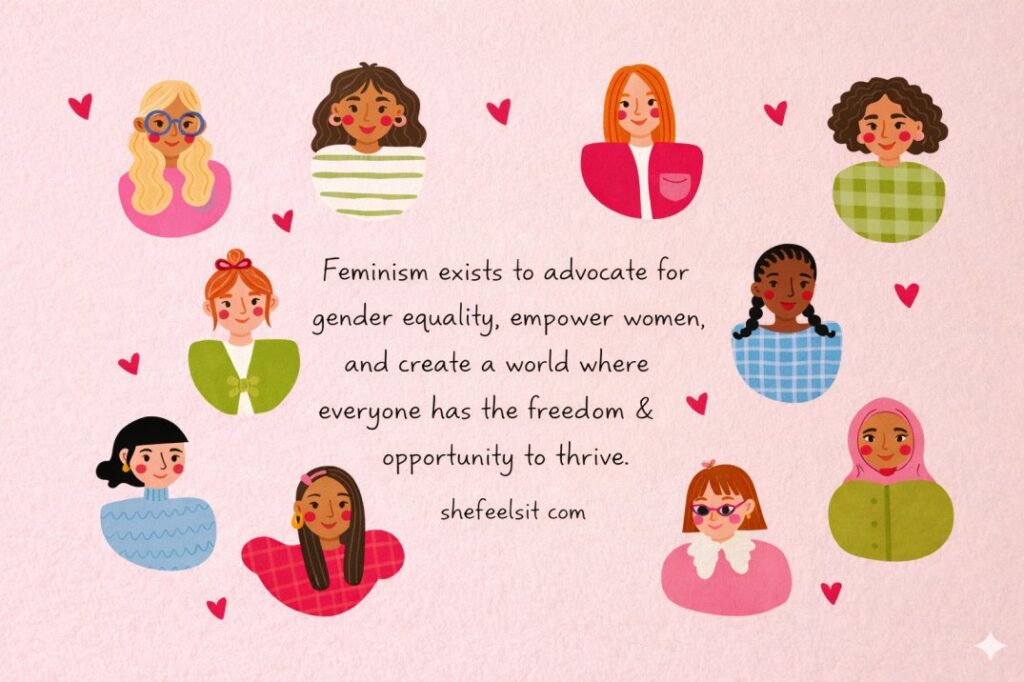
Feminism is a social, political, and cultural movement aimed at achieving equality between genders.
It focuses on:
- Equal rights and opportunities
- Freedom of choice
- Ending gender-based discrimination
- Challenging societal norms that limit individuals
At its heart, Feminism is not about women vs. men—it’s about creating a balanced society where everyone has equal opportunities.
A key influence on modern feminism comes from Simone de Beauvoir and her famous book The Second Sex. In this book, she explained a powerful idea: women are not simply “born” to act or live a certain way. Instead, society, culture, and upbringing shape how women are expected to behave.
In simple terms, she believed that gender roles are created by the world around us, not fixed by nature. This idea helped people question unfair expectations placed on women and encouraged them to think differently about equality.
Types of Feminism
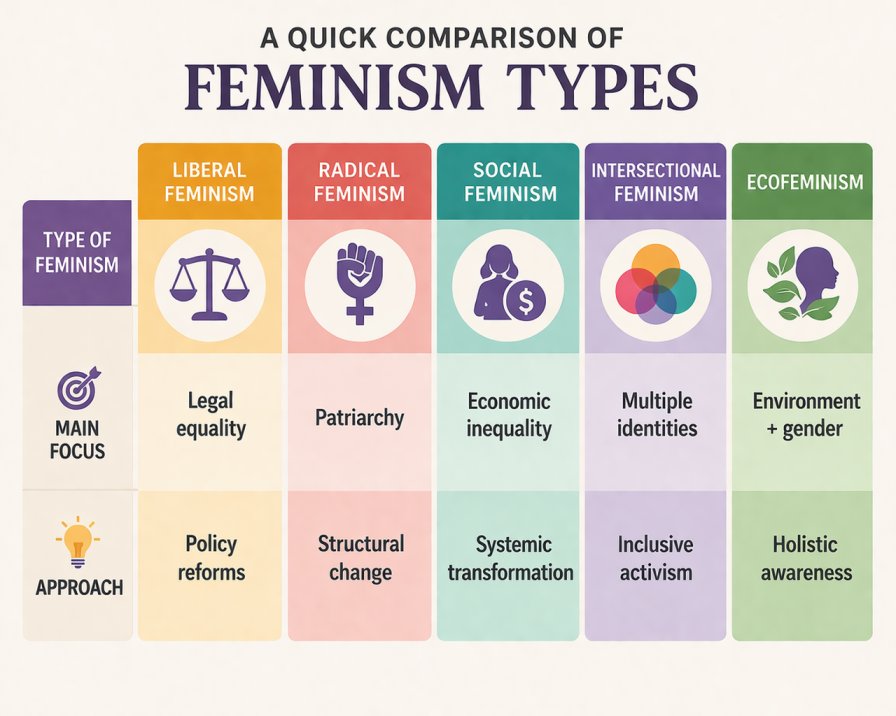
Feminism is not a single, uniform ideology. It has evolved into different branches, each addressing specific issues.
1. Liberal Feminism
Focuses on achieving equality through laws, education and jobs.
Key ideas:
- Equal pay
- Equal education
- Workplace rights
Modern-day example:
Today, when companies create policies for equal pay or when women are encouraged to join fields like engineering or leadership roles, it reflects liberal feminism in action.
2. Radical Feminism
It examines the root causes of gender inequality, often pointing to patriarchal systems (male-dominated power structures) and pushes for deeper social change.
It questions:
- Traditional gender roles
- Power structures in society
- Cultural norms that reinforce inequality
Modern-day example:
A strong example is the #MeToo movement, where women across the world shared their experiences of sexual harassment and demanded major changes in how society handles these issues.
3. Social Feminism
It is when people work to improve both women’s rights and their economic conditions at the same time.
It highlights:
- Economic inequality
- Labor exploitation
- Class differences
Modern-day example:
A real-life example is Self-Employed Women’s Association (SEWA), which supports women workers by giving them better pay, job security, and access to healthcare and banking services.
4. Intersectional Feminism
It is understanding that not all women face the same kind of struggles—because factors like race, class, caste, religion, or disability can affect their experiences differently.
For example:
- A wealthy woman and a poor woman may both face gender discrimination, but the poor woman may also struggle with financial hardship and limited opportunities.
- In India, when activists work to support Dalit women facing both caste-based discrimination and gender inequality
5. Ecofeminism
Ecofeminism believes that the exploitation of nature and the oppression of women are connected, and both need to be protected and respected.
For example:
A famous real-life example is the Chipko Movement, where village women hugged trees to stop them from being cut down. Their action was not just about saving trees, but also about protecting their livelihood and community.
Historical Feminism: How It All Began
Feminism didn’t appear overnight—it evolved through waves of movements.
1. First Wave (19th – early 20th century)
Focused on basic rights like voting and property ownership. The Seneca Falls Convention was the first women’s rights convention held in the United States, marking a major starting point of the organized feminist movement. It took place in 1848 in Seneca Falls, New York, where a group of women and men came together to discuss the lack of rights for women, especially in areas like voting, education, and property.
2. Second Wave (1960s – 1980s)
The Second Wave of Feminism focused on expanding women’s rights beyond just voting, addressing issues in everyday life like work, family, and personal freedom.
Key Focus Areas:
- Workplace equality and equal pay
- Reproductive rights and body autonomy
- Breaking traditional gender roles
- Legal rights in marriage and family
3. Third Wave (1990s – 2000s)
This wave challenged the idea that all women have the same experiences. It recognized that factors like race, class, culture, and identity shape different realities for women.
Key Focus Areas:
- Celebrating individual choices and identity
- Embracing diversity and inclusion
- Expanding ideas of beauty, gender, and expression
4. Fourth Wave (2010s – Present)
The Fourth Wave of Feminism focuses on digital activism, gender equality, and fighting harassment and discrimination in modern society.
A powerful example is the #MeToo movement, where women shared their experiences and demanded accountability.
Key Focus Areas:
- Ending sexual harassment and violence
- Gender equality in all areas of life
- Body positivity and self-expression
What is Pseudo-feminism
Pseudo-feminism is when someone uses the name of feminism, but their actions or beliefs go against the true goal of equality. They may spread misunderstanding, promote unfair bias, or focus on one-sided views rather than real equality.
Example:
- If someone says feminism means women should be superior to men, that is pseudofeminism—because real feminism is about equal rights, not dominance.
- Another example is when a person supports women’s rights only when it benefits them personally but ignores fairness or equality in other situations.
Why Feminism is Important in Today’s World
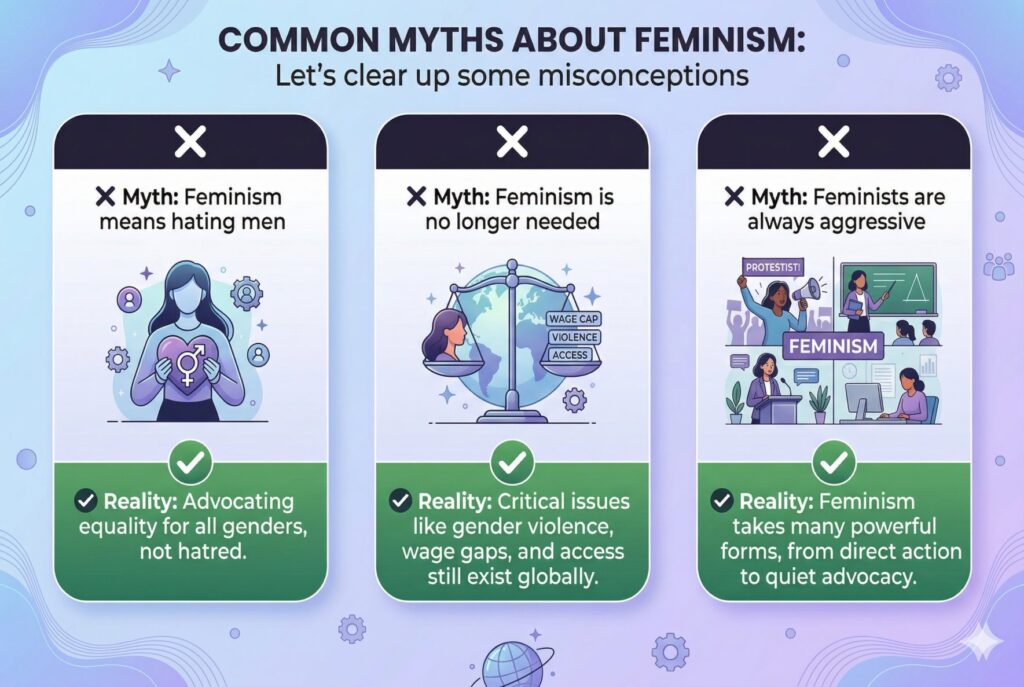
Even in today’s modern society, true equality is still a work in progress. Many challenges continue to affect people, especially women:
- Wage gaps still exist
- Gender-based violence continues
- Opportunities are not always equal
This is where feminism plays a powerful role.
Feminism helps to:
- Create awareness about inequality and injustice
- Drive policy changes that promote fairness and rights
- Empower individuals to speak up and take control of their lives
It encourages people to question unfair systems and work towards a more balanced and just society.
Conclusion
Feminism is not a fixed idea—it’s constantly evolving.
It grows with society, adapts to new challenges, and reflects the voices of each generation. Whether through large movements or small personal choices, Feminism continues to shape a more equal world.
The real question isn’t “Do we need Feminism?”
It’s “How can we contribute to equality in our own way?”
Call to Action (CTA)
What does Feminism mean to you?
Share your thoughts in the comments, start conversations, and challenge perspectives. If you found this blog helpful, explore more content on social change and empowerment—and don’t forget to share this with someone who needs a fresh perspective.
Have a story to share or a question to ask? This is a judgment-free zone. We read every comment and messages.